A professional injection molding supplier normally provides DFM review, material selection, mold engineering, toolmaking, sampling, production molding, inspection, finishing, assembly, packaging, and long-term mold maintenance. A production program may involve 20–200+ mold components, cycle times from roughly 10 to 90 seconds, and annual volumes from 10,000 to several million parts. Dimensional control also varies by resin: published molding guidance shows shrink-related tolerance ranges around 0.002 in./in. for relatively stable materials such as ABS or PC and up to 0.025 in./in. for less stable elastomeric materials. The supplier therefore manages far more than the molding press itself.
The work usually starts before steel is cut. Engineers review the 3D model, 2D drawing, resin specification, annual volume, appearance requirements, mating parts, tolerance scheme, and expected operating environment. In a DFM review, they check wall thickness, draft, ribs, bosses, undercuts, gate position, ejector locations, weld lines, venting, parting lines, and areas likely to warp or sink. A common starting point for draft is 1–2°, while heavily textured surfaces may need about 5° or more.
That geometry review then feeds into material selection because the same part can behave very differently in ABS, PC, nylon, POM, TPE, or glass-filled resin. Resin choice affects mold temperature, drying, flow length, shrinkage, wear, part stiffness, surface finish, chemical resistance, and achievable dimensions. Published molding guidance recommends keeping thinner wall areas around 40–60% of the thickest adjacent section in many designs rather than allowing abrupt thickness changes that cool at different rates.
| Material family | Typical reason for use | Production point to check |
|---|---|---|
| ABS | Housings, consumer products, good surface finish | Moderate shrinkage and visible flow marks |
| PC | Impact-resistant covers and technical housings | Higher processing temperature and moisture control |
| PA | Mechanical parts, clips, gears | Moisture absorption and dimensional change |
| POM | Low-friction mechanical components | Controlled processing and venting |
| TPE/TPU | Seals, grips, soft-touch parts | Adhesion, shrinkage, and ejection |
| Glass-filled grades | Higher stiffness | Greater mold wear and fiber-related warpage |
Once the material and geometry are workable, mold engineering becomes much more specific. The supplier selects cavity count, mold steel, gate style, runner layout, cooling circuits, ejection method, slides, lifters, inserts, and hot-runner components where appropriate. A four-cavity mold can theoretically produce four parts per cycle instead of one, but cavity balance, press shot size, clamping force, cooling, and runner layout must support the higher output. For a 30-second cycle running 20 hours per day, four cavities represent a theoretical 9,600 molded pieces per day before downtime and rejects.
A mold quote should therefore describe more than the number of cavities. Steel grade, insert construction, expected production volume, runner type, interchangeable components, surface specification, and spare-part policy have a large effect on how the tool performs after 100,000 or 1,000,000 cycles.
Tool manufacturing follows the approved mold design. CNC milling forms major cavity and mold-base geometry; EDM is often used for narrow ribs, deep features, sharp internal details, or geometry that cutting tools cannot reach easily; wire EDM can produce precision profiles in hardened metal. Grinding, drilling, polishing, fitting, and inspection complete the mold. Surface requirements can range from visible machining marks to polished cosmetic surfaces. One published insert-molding guide lists finishes around 10–12 Ra for a 600-grit stone finish and about 1–2 Ra for a finer diamond-buffed finish, showing how much appearance requirements can change tooling work.
The finished mold then moves into sampling rather than full production. During a first trial, technicians establish melt temperature, mold temperature, fill speed, injection pressure, holding pressure, cooling time, screw recovery, clamp settings, and ejection conditions. Parts are checked for flash, short filling, sinks, burns, flow marks, weld lines, drag, dimensional change, and warpage. If a 16-cavity tool produces one defective cavity every cycle, 6.25% of theoretical output is already affected, so cavity-by-cavity inspection matters before volume increases.
Sampling also provides the first useful dimensional record. A professional supplier can inspect parts using calipers, micrometers, height gauges, pin gauges, optical systems, fixtures, and coordinate measuring machines. Tolerance requirements should be set for plastic behavior rather than copied from metal drawings. ISO 20457:2026, published in August 2026, specifically addresses dimensional and geometrical tolerances for molded plastic parts and notes that material behavior, shrinkage, warpage, geometry, and cooling can produce greater dimensional variation than is normally expected in metal components.
After sample approval, production control becomes a repeatability problem. The supplier should record the approved process window rather than allow each operator to choose new settings. Melt temperature, injection speed, transfer position, holding pressure, cooling time, and mold temperature influence dimensions and appearance. A process running at a 25-second cycle produces about 144 shots per hour; with eight cavities, that is 1,152 theoretical parts per hour. A change of only 3 seconds raises the cycle to 28 seconds and reduces theoretical hourly output to about 1,029 parts, roughly 10.7% less capacity.
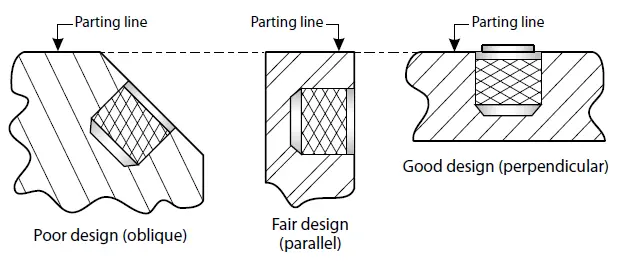
A qualified OEM injection molding supplier may also handle insert molding and overmolding when the finished component contains metal hardware or more than one polymer. Insert molding can encapsulate threaded brass inserts, terminals, pins, bushings, or other prepared components. Overmolding can place TPE or TPU over a rigid substrate for sealing, grip, impact protection, or assembly features. Published design guidance uses about 2° draft for many molding situations, with 3° or more around some shutoffs and textured features, because added surface texture increases resistance during ejection.
Production does not always end when a molded part leaves the machine. Many programs require ultrasonic welding, heat staking, threaded-insert installation, pad printing, screen printing, laser marking, painting, adhesive bonding, gasket fitting, mechanical assembly, or functional checks. Keeping these operations under one controlled production route reduces repeated receiving inspections and avoids sending semi-finished parts through several independent subcontractors. For an assembly containing 12 molded and purchased components, even a 99% acceptance rate for each independent component would produce only about an 88.6% mathematical probability that all 12 components individually pass if the rates were independent, showing why incoming control and assembly inspection still matter.
Quality documentation should match the application rather than use one inspection plan for every molded item. A simple consumer housing may require appearance criteria and several dimensional checks, while automotive, medical, electrical, or industrial parts can require material certificates, first-article reports, gauge records, lot identification, capability studies, control plans, or customer-specific approval files. ISO 20457 first appeared in 2018 and was replaced by the 2026 edition, reflecting the continuing use of plastics-specific dimensional rules rather than metal-based tolerance assumptions.
Inspection frequency also changes with production conditions. A supplier might approve the first pieces after startup, inspect defined dimensions every set number of hours or cycles, and repeat checks after resin changes, machine stops, mold maintenance, or process adjustments. The useful question for a buyer is not whether a factory owns a CMM, but which dimensions are measured, at what frequency, with what gauge, under what conditioning requirements, and what happens when 1 sample in a 20-piece inspection group falls outside the drawing requirement.
Packaging is another manufacturing operation when appearance or dimensional stability matters. Gloss housings may need individual bags or separators; optical parts can require controlled handling; long or thin molded components may need trays that prevent bending during transport. If 2% of otherwise acceptable parts are scratched in bulk packaging, the molding process can run correctly while the delivered lot still fails the customer's appearance requirement. Packaging specifications therefore belong in the approved production documentation before regular shipments begin.
The relationship continues through mold maintenance because production tools contain moving and wearing parts. Ejector pins, slides, lifters, gate inserts, seals, hot-runner components, cavity surfaces, and cooling passages need scheduled inspection. Maintenance can be tied to shot counts, resin type, tool condition, or production history. A tool running 500,000 cycles with a glass-filled engineering resin generally places different demands on cavity surfaces and moving components than a 20,000-cycle program using an unfilled commodity resin.
Engineering changes often arrive during that service period. A customer may change a mounting hole, logo, snap feature, connector opening, sealing surface, or mating dimension after the mold has entered production. The supplier must determine whether steel can be removed, whether new inserts are needed, whether metal must be added by repair and re-machining, and whether the modification affects cooling or ejection. A modification costing 10% of the original tool price may be reasonable when an insert can be replaced; a geometry change crossing the parting line or moving major slides can require much more rebuilding.
For purchasing teams, comparing suppliers therefore works better when the quotation is broken into engineering, tooling, sampling, piece price, secondary work, inspection, packaging, maintenance, and freight assumptions. A part quoted 8% cheaper is not necessarily less expensive if it needs a longer molding cycle, produces more runner waste, requires outside finishing, or uses a mold with shorter service intervals. Production volume should also be included: saving $0.04 per part equals $4,000 across 100,000 units but $80,000 across 2 million units, while a more expensive mold can become economical when higher cavity count or shorter cycle time lowers unit cost over the full program.