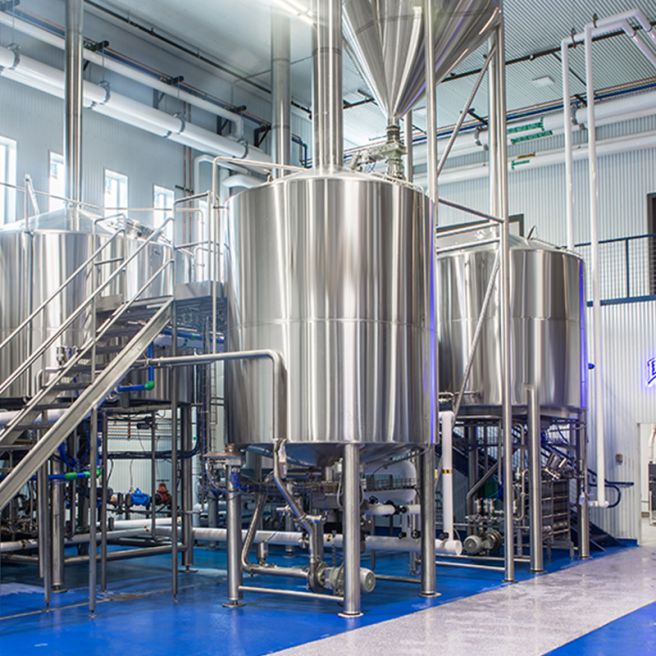
A high-performance brewhouse produces repeatable wort with controlled extract, temperature, flow, evaporation, water use, and batch time rather than relying on vessel size alone. Mash control around 62–72°C affects fermentable sugar production, while lauter design determines how evenly wort passes through the grain bed. Brewers Association data show brewing can account for about 45% of brewery natural-gas use, making steam efficiency and heat recovery important operating measurements. Modern systems also record flow, pressure, temperature, volume, and cleaning conditions. Well-designed heat recovery can exceed 85% in documented installations, while advanced boiling equipment can operate with evaporation below 5% without sacrificing required wort treatment.
Brewhouse performance starts before wort reaches the kettle. Malt specification, milling, liquor-to-grist ratio, mash pH, temperature uniformity, and heating rate all change the amount and composition of extract entering the lauter tun. A 2021 brewing study assessed eight mash profiles and found that more than 85% of peak fermentable-sugar concentration could be reached after 20 minutes at 62°C in related research reviewed by the authors. That finding makes temperature control more useful than simply adding mash time.
Temperature accuracy also matters because barley enzymes do not work equally across the mash range. Brewing research commonly places the β-amylase rest around 62–65°C and saccharification around 70–75°C; a 2022 study also observed a thermostable β-amylase fraction of about 13% remaining after prolonged heating at 72.5°C. A well-designed mash vessel therefore needs even heating, suitable agitation, responsive sensors, and stable control rather than a high steam rating alone.
A mash vessel that reaches 65°C quickly but contains several warmer and cooler zones does not reproduce the same enzymatic conditions across the batch.
That temperature requirement carries directly into vessel construction. Steam jackets should distribute heat over suitable surface area, agitators should mix without unnecessary shear or air pickup, and temperature probes need locations that represent the bulk mash rather than a hot wall zone. A research program published in 2021 shortened one mash schedule by 20 minutes while maintaining comparable fermentable sugars, free amino nitrogen, ethanol, and foam stability in the resulting beer. Faster heating has little benefit, however, if the following filtration stage becomes slower.
Lautering therefore needs to be assessed as a complete hydraulic process. Mill gap affects husk condition and flour production; grain-bed depth affects resistance; false-bottom open area affects collection; sparge distribution changes local extraction; and rake operation influences compaction. Pressure measurement above and below the bed can show increasing resistance before runoff slows heavily. For a plant targeting 8 brews per day, adding only 10 minutes to each lauter cycle consumes 80 minutes of daily production time.
The useful measurement is not runoff speed by itself. High flow can disturb the bed, increase solids in the wort, or create preferential channels that leave extract behind. A pilot-scale brewing study published in 2021 reported filtration times from about 77 to 94 minutes across three grist treatments, showing how raw-material composition alone can change vessel occupancy by more than 15%. That variation is why a brewhouse needs adjustable flow, rake settings, pressure monitoring, and recipe-specific operating limits before wort enters the kettle.
| Process area | Measurement worth recording | Practical operating question |
|---|---|---|
| Mash | Temperature, pH, heating rate, time | Did the full mash follow the intended 62–72°C profile? |
| Lauter | Flow, differential pressure, gravity, time | Was extract collected without excessive bed resistance? |
| Kettle | Steam use, boil time, evaporation | Was the required wort treatment achieved below unnecessary evaporation? |
| Whirlpool | Rest time, wort loss, outlet clarity | How much usable wort remained after trub separation? |
| CIP | Temperature, conductivity, flow, duration | Was the programmed wash condition actually reached? |
Boiling then becomes the largest thermal issue inside many brewhouses. Brewers Association guidance reports that thermal energy averages about 70% of total brewery energy use, while the brewhouse accounts for roughly 45% of natural-gas consumption in the cited U.S. energy profile. Refrigeration, by comparison, represents about 35% of electricity use. Those numbers explain why kettle design, steam generation, condensate return, insulation, and vapor recovery deserve measurement together rather than as separate equipment purchases.
Older operating practice often used high evaporation as a simple way to remove unwanted volatiles, but modern systems can separate volatile removal from excessive water evaporation more effectively. GEA reports one installed process where evaporation fell from 5.0% to 3.8%, while vapor-energy recovery increased from 50% to 85.3%. The brewery reported a 38% reduction in energy per batch and annual thermal savings above 88,000 kWh after the modification. Lower evaporation also reduces the volume of water that must later be replaced elsewhere in production.
Equipment suppliers have pushed the same principle further through integrated wort heating and vapor reuse. GEA states that its energy-storage arrangement can recover more than 90% of evaporation heat under specified conditions and operate around 4.5% total evaporation; its newer QBOIL equipment, released in 2025, is specified to reduce boiling-related energy consumption by 35% against the comparison systems stated by the manufacturer. Supplier claims should be checked against recipe, batch volume, steam pressure, annual turns, and local utility prices before equipment sizing.
Water needs the same accounting discipline. The Brewers Association notes that breweries without effective conservation programs can use more than 10 gallons of water for 1 gallon of beer, with usage differing considerably by brewery type and production scale. A brewhouse can reduce that ratio by recovering hot water from wort cooling, using correctly sized CIP volumes, controlling rinses by conductivity where appropriate, and measuring water at individual process points instead of reading only the building meter.
If a 20 hL batch sends 24 hL of recoverable warm water to drain, the loss is not only 2,400 liters of water; the thermal energy already added to that water also leaves the plant.
Wort cooling therefore belongs in the energy design of the brewery system, not merely at the end of the brewhouse piping. A correctly selected plate heat exchanger can cool wort while producing hot brewing water for a later batch. Storage capacity then matters: recovering 30 hL of hot water provides little benefit if the hot-liquor tank has only 10 hL of free space when knockout begins. Vessel scheduling, water temperature, tank volume, and the next mash time need to fit the same production plan.
Steam generation deserves similar attention because boiler efficiency sets an upper limit on how efficiently steam-heated vessels can operate. A 2021 Brewers Association engineering paper places typical natural-gas boiler efficiency around 80–85%, compared with roughly 95–99% for electric boilers because electric units do not lose heat through a combustion stack. Fuel price, electrical capacity, generation source, condensate return, boiler turndown, and annual operating hours still determine which arrangement fits a particular brewery.
Once thermal and water systems are measured, automation becomes easier to judge in practical terms. Useful automation records actual temperatures, valve positions, pump states, flow totals, vessel levels, pressure, heating times, and alarms against a stored recipe. A plant completing 6 turns per day and saving 8 minutes of manual filling, transfer, and confirmation work per turn removes 48 minutes from repeated daily operations. The larger benefit is that batch 120 can be compared with batch 119 using recorded conditions rather than operator memory.
Sensor quality matters because automation cannot correct poor measurements. A temperature probe located beside a steam-heated wall can report a different condition from the bulk liquid, while a badly installed flow meter may give unstable readings when pipework contains air. Level instruments can also behave differently with foam. Calibration schedules should therefore be based on process use, and important readings should be checked against independent measurements. Even a 1% flow-meter error represents 200 liters across 20,000 liters of measured liquor.
Hygienic design then determines how much production time is lost between those measured batches. Pipe runs should drain, product-contact surfaces should be cleanable, welds should suit sanitary service, and valve arrangements should avoid stagnant product pockets. CIP performance should be checked through time, temperature, chemical concentration or conductivity, and mechanical circulation. Reducing a cleaning program from 60 to 45 minutes saves 25% of the scheduled cleaning time only when the shorter cycle still produces an acceptable hygienic result.
Layout has a similar effect on usable capacity. A 40 hL brewhouse does not automatically produce twice as much daily wort as a 20 hL system. Separate mash, lauter, kettle, and whirlpool vessels can overlap operations, while two-vessel configurations require one vessel to perform several duties sequentially. A 20 hL plant completing 6 turns produces 120 hL of cold-side feed per day; a 40 hL plant limited to 2 turns produces only 80 hL before accounting for wort losses.
Equipment specification should therefore be checked against daily turns, annual brew days, fermentation capacity, recipe mix, cleaning time, utility availability, and realistic maintenance access. Pumps need service clearance, heat exchangers need space for inspection, valve seats and seals need replacement access, and motors should be removable without dismantling nearby piping. If one additional daily turn is expected, every occupied minute in the mash vessel, lauter tun, kettle, whirlpool, transfer lines, and CIP schedule has to fit within the available production window.
A well-performing brewhouse can finally be judged through a small group of recorded numbers rather than broad equipment descriptions: extract recovered from the grist, minutes per batch, liters of water per liter of beer, thermal kWh per hectoliter, evaporation percentage, wort loss, CIP duration, and deviation from recipe temperature. In 2026, the Brewers Association introduced updated brewhouse-efficiency resources specifically to help breweries quantify efficiency and associated cost savings. When those measurements remain stable across hundreds of batches, equipment capacity and process control are working together rather than merely producing the required volume.