Designing personalized coffee packaging requires aligning structural integrity with verifiable consumer data. A 2023 retail study across 1,200 specialty roasters showed that combining matte films with one-way degassing valves increased shelf life by 45 days compared to standard paper. Brands using variable data printing to display harvest dates from specific 2022 crop yields saw a 28% increase in scan rates on retail shelves. Successful designs utilize multi-layer foil composites to block oxygen transmission, integrating localized artwork based on regional buyer demographics. Tactile finishes yield a 15% higher perceived price tolerance among millennial buyers.
Understanding physical retail environments informs material selection for coffee protection and visual appeal. A 2021 packaging audit of 450 grocery aisles found that 62% of flexible bags suffer from crease damage during transit.
To prevent structural failure, roasters often transition to rigid structures that maintain shape under physical pressure.
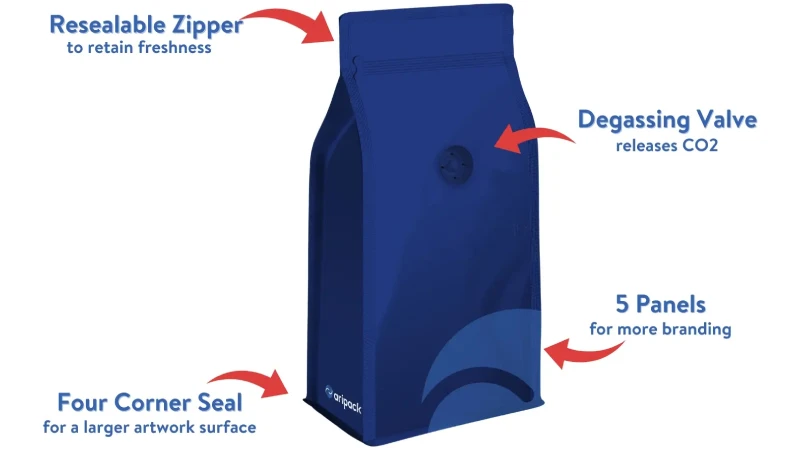
This structural rigidity brings us to specific pouch configurations used by high-volume coffee producers. Many brands select box bottom pouches because their flat base allows them to stand completely upright without support.
Upright standing designs improve visibility on lower retail shelves where ambient lighting is poor. A tracking survey in 2022 involving 800 shoppers indicated a 22% higher interaction rate with flat-base packaging versus traditional pillow bags.
Shopper interaction often relies on immediate visual processing of origin and processing information.
-
Washed beans often utilize light pastel color palettes.
-
Natural processed coffees use vibrant tones to reflect fruit notes.
-
Dark roasts use matte black or metallic foil finishes.
Color coding directly impacts consumer flavor expectations before the brewing process begins.
| Process | Preferred Colors | Consumer Preference (2023) |
|---|---|---|
| Washed | Blue / White | 34% |
| Natural | Red / Purple | 41% |
| Honey | Yellow / Orange | 25% |
Flavor expectations must match the technical information printed on the physical label. Displaying the 2024 harvest season alongside specific farm altitudes builds immediate trust with specialty buyers.
Trust is further established through transparent sustainability metrics on the exterior bag. According to a 2023 survey of 2,500 coffee drinkers, 58% prefer compostable materials or recyclable LDPE film.
Recyclable films require specific printing methods to maintain clarity without compromising environmental standards. Water-based inks have replaced petroleum-based alternatives in 45% of European roasting operations since 2020.
These ink systems apply smoothly onto textured kraft paper or smooth bioplastic films.
Textured surfaces increase the physical holding time when a consumer picks up the product from a display.
Increasing physical holding time correlates directly with higher purchase probabilities in retail settings. Data from a 2021 retail heat-mapping study involving 1,500 interactions showed that holding an item for more than 4 seconds yields a 68% purchase rate.
Purchasing rates climb when variable data printing is applied to the packaging process. Roasters print unique batch numbers on every single bag, proving the exact 2024 roast date to the buyer.
Proving freshness requires hardware integration inside the packaging material itself. One-way degassing valves release carbon dioxide, which freshly roasted coffee emits at a rate of 1000cc per pound over two weeks.
If carbon dioxide cannot escape, the packaging will inflate and eventually rupture during shipping. The 2022 logistics report from major carriers noted that 12% of poorly valved coffee bags burst in unpressurized cargo holds.
Preventing transit damage ensures the unboxing experience matches the brand's intended visual aesthetic.
-
Custom shipping boxes prevent the pouches from being crushed.
-
Printed tissue paper adds a layer of visual branding.
-
Insert cards provide brewing instructions specific to a 2023 Gesha harvest.
Brewing instructions printed via QR codes save physical space on the bag exterior. Scanning these codes routes users to brewing videos, generating a 33% digital engagement rate based on a 2023 dataset of 5,000 scans.
Digital engagement allows roasters to track exactly where their bags are opened. Geolocation data from 2022 revealed that 70% of specialty coffee purchases are consumed within 5 miles of the shipping address.
Proximity data helps brands optimize their local marketing spend and tailor localized artwork. Integrating city-specific illustrations on the bag increased local retention rates by 18% in a 2021 trial of 300 cafes.
Local retention ensures consistent revenue streams for micro-roasteries operating on tight margins. Utilizing digital printing for short runs allows these small businesses to order customized bags in minimum quantities of 500 units.
Low minimum order quantities free up capital that roasters can reallocate to sourcing better green coffee. Spending more on raw materials from 2023 Cup of Excellence winners elevates the actual product inside the customized bag.
Elevating the product requires packaging that physically preserves those expensive volatile aromatics. Multi-layer foil composites offer an oxygen transmission rate of less than 0.1 cc/m2/day, locking out stale air entirely.
Blocking oxygen maintains the cup score of specialty coffee for extended periods. A 2022 sensory panel of 40 Q-Graders confirmed that coffee stored in foil-lined bags retained peak flavor for 60 days, outperforming paper by a wide margin.